ALUMNI ACHIEVERS AWARDED AT 11TH CONVOCATION OF NERIST
Dr. Sarat Kumar Dash, Scientist G and a Division Head at ISRO Centre, Bangaluru.
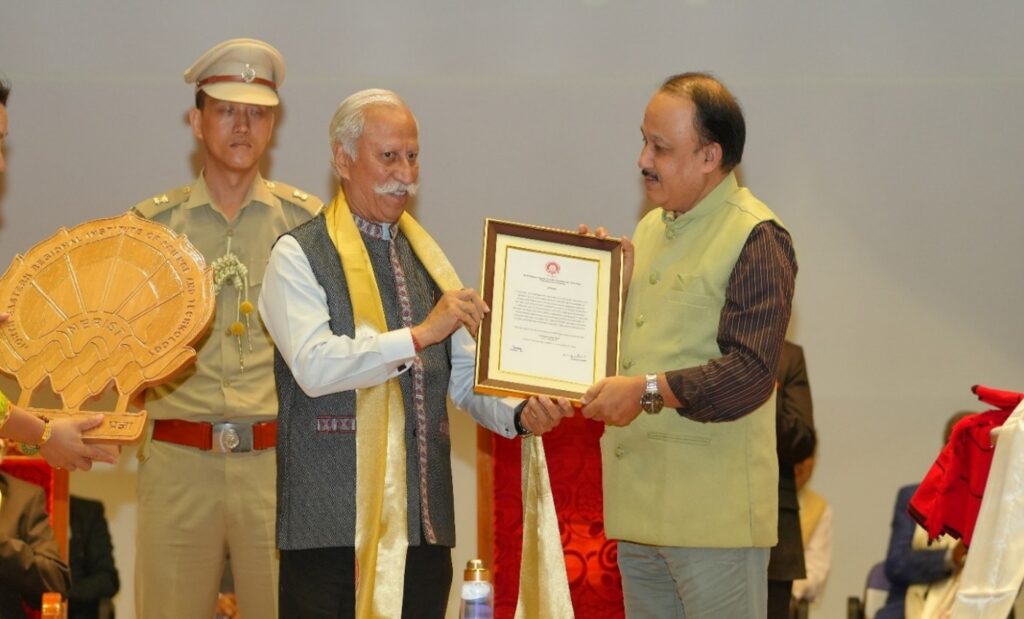
His Excellency, Lt. Gen. Kaiwalya Trivikram Parnaik, Governor of Arunachal Pradesh and President of the NERIST Society, presenting Alumni Achiever Award to Dr. Sarat Kumar Dash, Scientist G and a Division Head at ISRO Centre, Bangaluru, for his contribution to the success of Chandrayaan 3 Mission.
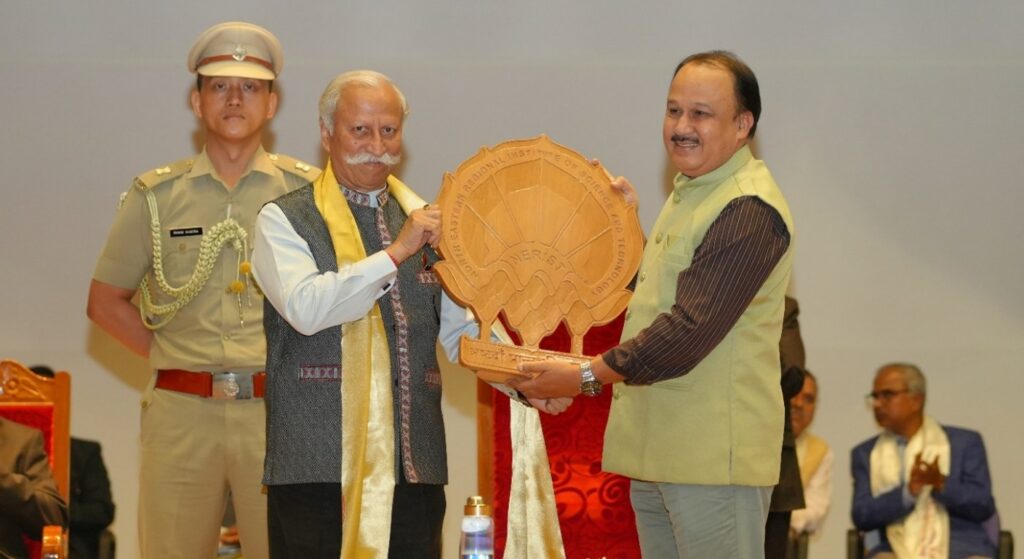
His Excellency, Lt. Gen. Kaiwalya Trivikram Parnaik, Governor of Arunachal Pradesh and President of the NERIST Society, presenting Alumni Achiever Award to Dr. Sarat Kumar Dash, Scientist G and a Division Head at ISRO Centre, Bangaluru, for his contribution to the success of Chandrayaan 3 Mission.
Dr. Sarat Kumar Dash, Scientist G, worked for his Ph.D. degree in the field of Liquid Crystals from 1994 to 1998 in the Department of Physics, NERIST. He joined ISRO in 1998 and currently, he is the Head of the Component Quality Assurance and Control Division of UR Rao Satellite Centre (ISRO), Bangaluru.
Contribution to the Success of Chandrayaan-3 Mission
Electrical, Electronic and Electromechanical (EEE) Components are the basic building block of higher-level assemblies (Spacecraft in this case). Therefore, Reliability of a spacecraft is dependent on reliability of each and every component. More than 200 types (~1,50,000 nos.) EEE Components are used in Chandrayaan-3 Spacecraft. Component Quality Assurance Division headed by Dr. Sarat Kumar Dash ensured reliability and quality of each and every component used in Chandrayaan-3.
For interplanetary mission, the EEE component can experience extreme temperature environment, i.e., -200oC to +200oC (on the surface of Moon, Mars, and Venus, etc.), which is beyond the specified temperature range of components. His division carried out extreme low and high temperature tests on each component type to ensure their survivability and functionality at extreme temperatures.
High Energy Particles (originating from Sun) pose risk to all planets and their moons. Trapped Radiation around a planet depends upon local magnetosphere. Therefore, Radiation Hardness Assurance (RHA) program developed by his division, for interplanetary mission was carefully designed to assure that the on board EEE parts perform their intended functions despite the harsh environment.
Moreover, each and every component used in Chandrayaan-3 space-craft was certified by his division, in terms of reliability, quality, extreme temperature functionality and radiation environment survivability.