

- More




Antarikha Dutta , Neki Borang & Meera Yadav
https://doi.org/10.1080/10242422.2026.2703596
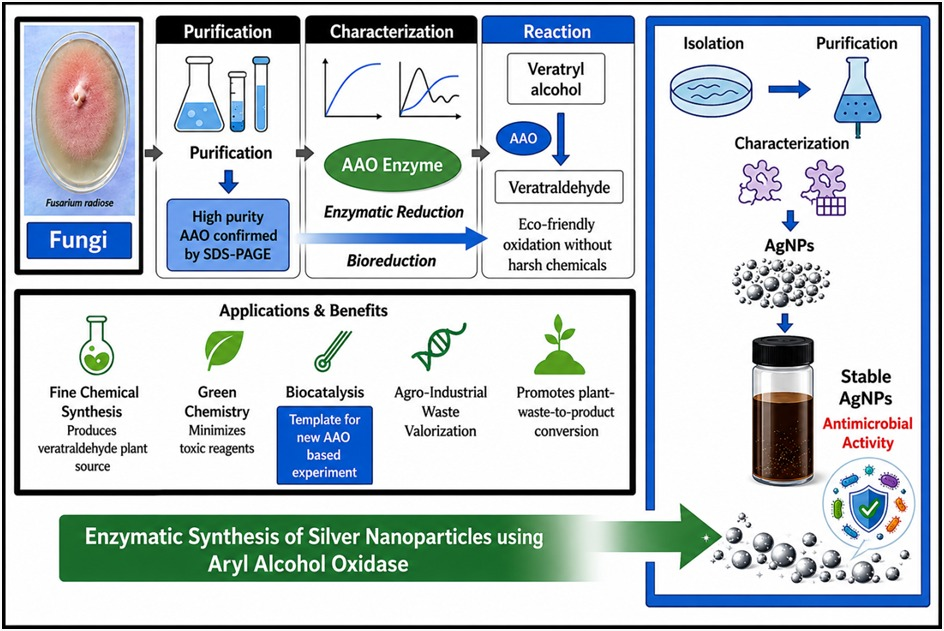
Silver nanoparticles (AgNPs) have gained considerable attention due to their antimicrobial, catalytic, and biomedical applications. However, conventional physical and chemical methods for nanoparticle synthesis often involve toxic reducing agents, high energy requirements, and environmentally harmful by-products. Enzyme-mediated synthesis provides a greener alternative by enabling metal ion reduction under mild reaction conditions. Keeping these points in view, the present study focused on an extracellular oxidoreductase exhibiting Aryl Alcohol Oxidase (AAO) activity obtained from the soil-derived fungal isolate Fusarium redolens. The enzyme was purified and characterized, and its catalytic potential for the synthesis of AgNPs was investigated. The purified AAO-like oxidoreductase successfully mediated the reduction of Ag⁺ ions under mild, reductant-free conditions, resulting in the formation of silver nanoparticles. The synthesized AgNPs were characterized by UV–Vis, SEM, EDX, FTIR, XRD, DLS and zeta potential analyses and exhibited antibacterial activity against the tested bacterial strains. Thus, the study highlights the potential of fungal AAO-like oxidoreductase as a sustainable biocatalyst for the eco-friendly synthesis of functional silver nanomaterials.
This enzyme-mediated approach offers potential for further exploration in green nanotechnology and biocatalytic nanoparticle synthesis.
*Corresponding Author, Dept. of Chemistry, NERIST, Nirjuli, Itanagar-791109 (AR)